Table of Contents
Quick Answer: Cority and Intelex are both enterprise grade EHS platforms built for mid to large organizations in regulated industries, and both rely on custom, quote based pricing rather than published rates. Cority has the deeper edge in occupational health, industrial hygiene, and ESG reporting, largely because it grew out of a medical records platform. Intelex has the deeper edge in quality management integration, mobile functionality, and accessibility for smaller teams through its newer Essentials tier. Neither platform is a quick, low complexity deployment, so the right choice comes down to which specific modules and implementation profile match your organization.
Why Safety Leaders Compare Cority and Intelex
When a safety, health, or compliance team starts shortlisting enterprise EHS software, Cority and Intelex show up together more often than almost any other pairing. Both platforms have decades of history, both serve large customer bases across regulated industries, and both offer a breadth of modules that goes well beyond a single point solution like inspection management or incident tracking alone.
That overlap is exactly why the comparison matters. Two platforms that look similar on a features list can behave very differently once you get into implementation timelines, module depth, and total cost of ownership. This comparison draws on publicly available vendor information and aggregated feedback patterns from review platforms including G2, Capterra, Software Advice, and Gartner Peer Insights, along with analyst recognition from Verdantix, to give safety leaders a clear, practical basis for deciding between the two.
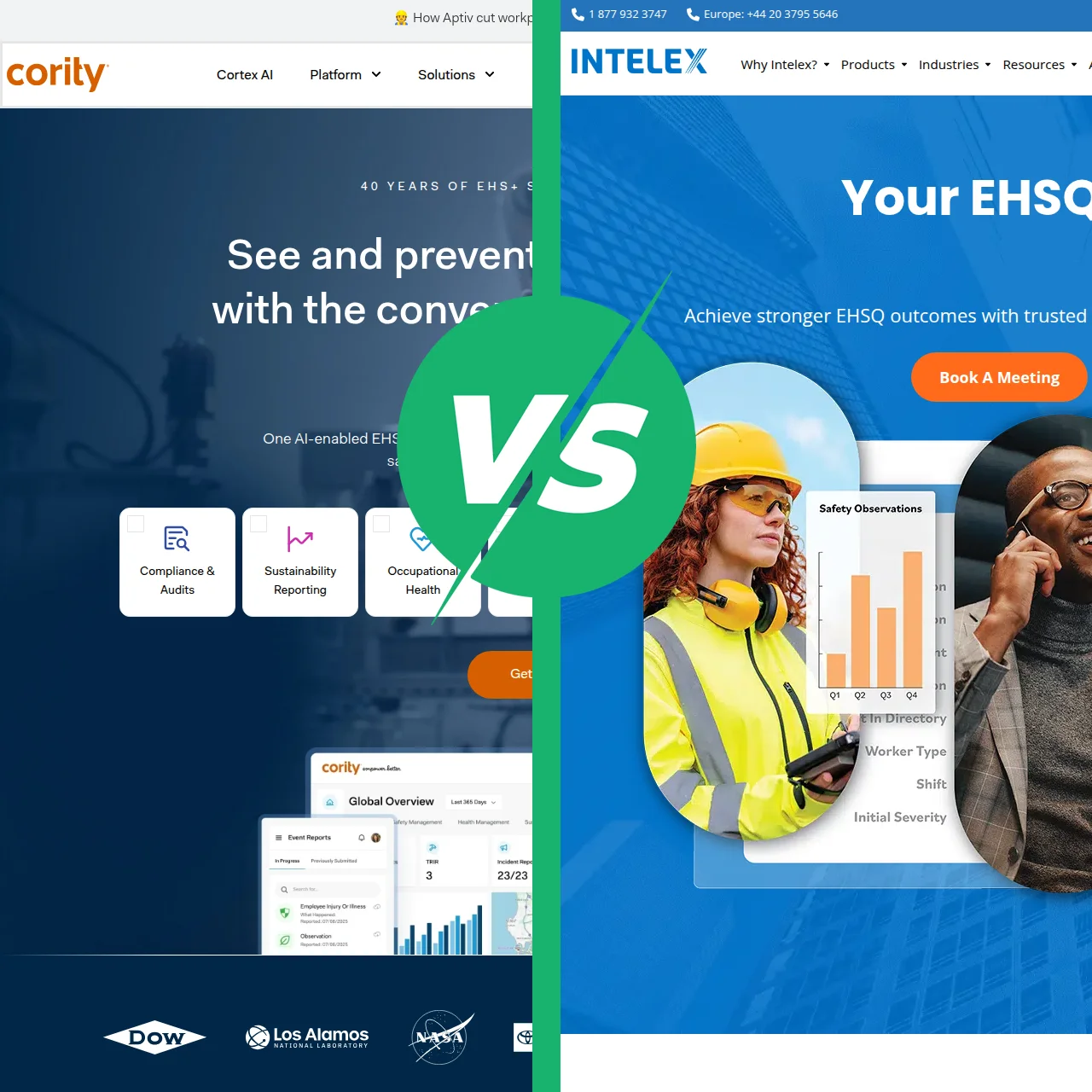
Cority vs. Intelex at a Glance
| Category | Cority | Intelex |
|---|---|---|
| Founded | 1985, as Medgate | 1992 |
| Ownership | Majority stake held by Thoma Bravo since 2019 | Wholly owned by Fortive Corporation (NYSE: FTV) |
| Customers | 1,500+ organizations worldwide | Nearly 1,400 clients, 3.5 million+ users |
| Core strength | Occupational health, industrial hygiene, ESG reporting | Quality management integration, reporting, configurability |
| SMB option | Limited | Yes, through Intelex Essentials, since 2025 |
| Implementation complexity | High | Medium to high |
| Pricing model | Custom quote, not published | Custom quote, not published |
| Notable recognition | Verdantix Green Quadrant Leader for EHS software and ESG reporting, 2025 | Verdantix #1 in Safety and Mobile; G2 Leader, Enterprise EHS Software Grid |
Company Background
Cority traces back to 1985, when it launched as Medgate, an occupational health records company. Over decades of acquisitions and rebranding, it grew into Cority, and its 2019 majority stake acquisition by private equity firm Thoma Bravo accelerated expansion into environmental management, ESG reporting, and industrial hygiene, most recently through the 2025 acquisition of occupational medicine software provider Meddbase. The company is headquartered in Canada and reports serving more than 1,500 organizations, concentrated in pharmaceuticals, healthcare, manufacturing, chemicals, and energy.
Intelex was founded in 1992 by Dr. Andrew Jaine and Ted Grunau and describes itself as the oldest independent vendor of EHS and quality software in North America, meaning it was built from the ground up as a dedicated EHS and quality platform rather than assembled from an unrelated starting point. Intelex is now a wholly owned operating company of Fortive Corporation, a publicly traded industrial technology conglomerate. With nearly 1,400 clients and over 3.5 million users across six continents, Intelex has spent 2025 and early 2026 in an unusually active stretch of product development, including the launch of Intelex Essentials, new risk management tools, a partnership with COMET for investigation methodology, and a formal AI framework called Input AI and Insight AI.
The ownership structures are worth noting on their own. Cority’s growth has been shaped by private equity backing and acquisitions, which tends to favor rapid expansion of capabilities. Intelex’s position inside Fortive gives it access to a large, publicly traded parent, which tends to favor steadier, longer horizon investment. Neither structure is inherently better, but it helps explain a pattern reviewers describe often: Cority’s platform can feel like several strong modules brought together over time, while Intelex’s platform tends to feel more like one system extended gradually.
Occupational Health: Cority’s Strongest Ground
Cority’s origin as a medical records platform still shows up clearly in its product today. The occupational health module supports medical surveillance, case management, return to work tracking, and industrial hygiene, and it includes AI powered medical transcription tools built specifically for clinicians. For organizations with in house medical staff, occupational health clinics, or heavy industrial hygiene monitoring requirements, this depth is difficult for most competitors, including Intelex, to match.
Intelex covers occupational health too, with injury and illness management, audits, inspections, and document control folded into its broader health and safety application. It is a capable module, but the available evidence does not point to the same medical records level depth that defines Cority’s approach. Organizations whose EHS needs are heavily centered on clinical occupational health functions should weight this difference seriously.
Quality Management: Intelex’s Strongest Ground
The reverse pattern shows up in quality management. Intelex markets itself explicitly as an EHSQ platform, and its quality module includes nonconformance tracking, supplier management, and quality audits, integrated with the same data used for safety and compliance. That integration matters for manufacturers and regulated producers who need quality and safety programs to share a single source of truth instead of living in separate systems.
Cority’s own materials describe quality management as part of its broader EHS+ scope, but the platform’s most detailed, well documented capabilities sit in safety, occupational health, environmental management, and ESG rather than in a fully built out quality module. Organizations where quality management is a primary requirement, not a secondary one, should press Cority specifically on this point during a demo.
ESG and Sustainability Reporting
Cority has invested heavily in ESG infrastructure, supporting multiple global disclosure frameworks such as GRI, CDP, and TCFD. Verdantix recognized Cority as a Green Quadrant Leader in both EHS software and ESG and sustainability reporting software for 2025, a dual distinction that few EHS vendors can claim.
Intelex’s environmental management module extends into sustainability tracking through its Advanced and Enterprise editions, and it covers water quality, waste, and air emissions reporting capably. However, the available evidence does not point to the same dedicated ESG reporting depth or analyst recognition in that specific category. Organizations with active or upcoming public ESG disclosure obligations should treat this as a meaningful point in Cority’s favor.
AI Capabilities Compared
Both vendors have made AI a visible part of their roadmap, though from different starting points. Cority’s Cortex AI can pre fill incident reports from dictated field input, analyze inspection photos to help complete checklists, and support medical transcription within the occupational health module. It is a set of practical, workflow embedded tools aimed at reducing manual entry.
Intelex has a longer AI development history, dating back to its acquisition of ehsAI, an early regulatory parsing AI tool, followed by a PhD led AI Lab established in 2022 and an AI Factory built in 2024. That groundwork was formalized in 2025 into two branded pillars, Input AI and Insight AI, guided by a stated principle that the software makes suggestions while humans make the decisions. Intelex’s AI investment appears more mature in terms of internal research infrastructure, while Cority’s AI features are more narrowly targeted at specific workflow tasks.
Ease of Use and Implementation
Neither platform is a lightweight, self service deployment, and safety leaders should plan accordingly. Cority users on G2 and Capterra generally describe the interface as workable once past an initial learning curve, but a recurring complaint is that different modules use inconsistent navigation logic, which can extend that learning curve for teams working across multiple functions.
Intelex draws a similarly split reaction. Users praise the depth of customization available, but that same flexibility means non IT staff often need real time to get comfortable with configuration. Both platforms typically require vendor consultants or implementation partners for a proper rollout, and neither should be expected to go live in days rather than weeks or months.
Intelex holds a specific advantage for smaller or less complex organizations through Intelex Essentials, launched in March 2025. It strips the platform down to core audit, incident, and risk management functionality with built in best practices, aimed squarely at teams that want Intelex grade capability without the full enterprise configuration burden. Cority does not currently offer an equivalent stripped down tier, which is reflected in its own guidance that organizations under roughly 250 to 500 employees may be better served elsewhere.
Pricing Comparison
Neither Cority nor Intelex publishes pricing, which is standard practice among enterprise EHS vendors but still worth flagging clearly for buyers building a budget.
| Pricing Factor | Cority | Intelex |
|---|---|---|
| Published pricing | None, custom quote only | None, custom quote only |
| Pricing structure | Modular, based on selected EHS+ clouds | Tiered by edition, Essentials, Advanced, Enterprise, plus user count |
| Free trial | Not specified in available vendor materials | Available, no credit card required |
| Implementation cost | Separate from licensing, varies by scope | Separate from licensing, varies by scope |
| Best next step | Request a quote and compare against reference customers | Request a quote and use the self guided demo builder |
Because both vendors quote individually, the only reliable way to compare actual cost is to request proposals from both platforms using the same internal requirements document, so the comparison reflects your organization rather than list prices that may not apply to it.
Customer Support
Support quality is close to a draw, with both vendors showing a similar mixed but positive pattern. Cority users frequently highlight responsive, knowledgeable support and point to resources like Cority Academy and an active user community, though a smaller group of reviewers describe slower responses on advanced technical issues.
Intelex shows the same split. Gartner Peer Insights reviewers often cite strong support, while other users report slow response times. Intelex backs its platform with a Customer Support Center, Intelex Academy, an EHSQ Community, and a self help portal, with training included at purchase. In both cases, buyers evaluating either platform should ask directly about support SLAs and dedicated account management before signing, rather than assuming enterprise pricing guarantees enterprise level responsiveness.
Which Should You Choose?
Choose Cority if:
- Occupational health, industrial hygiene, or clinical case management is central to your program
- You have active or upcoming ESG disclosure requirements under frameworks like GRI, CDP, or TCFD
- Your organization has more than roughly 500 employees and dedicated EHS or IT resources for implementation
- You operate in pharmaceuticals, healthcare, chemicals, or energy with heavy regulatory overlap
Choose Intelex if:
- You need quality management genuinely integrated with safety and compliance data, not managed separately
- Mobile functionality and field usability are a high priority
- Your organization is smaller or mid sized and could benefit from Intelex Essentials rather than a full enterprise deployment
- You operate across manufacturing, automotive, aviation, or multi site operations where configurability matters more than a single specialty like occupational health
For organizations that are enterprise scale, heavily regulated, and evaluating both seriously, the decision often comes down to which specific module carries the most operational risk. Occupational health and ESG needs point toward Cority, while quality integration and configurability point toward Intelex.
Final Verdict
Cority and Intelex both earn their place on enterprise EHS shortlists, and for similar reasons: decades of domain experience, broad feature coverage, and consistent recognition from analysts and reviewers. What separates them is specialization within that shared enterprise scope.
Cority’s roots in occupational health give it a genuine edge for organizations with clinical, industrial hygiene, or ESG heavy requirements. Intelex’s roots as a purpose built EHSQ vendor give it a genuine edge for organizations that need quality management tightly integrated with safety data, along with a real option for smaller teams through Intelex Essentials. Neither platform is the right answer for every organization, and neither publishes pricing, so the responsible next step is the same regardless of which direction you lean: request a live demo from both vendors, ask for reference customers similar to your size and industry, and compare total cost of ownership rather than headline features alone.
Frequently Asked Questions
Is Cority or Intelex better for large enterprises?
Both platforms are built for large enterprises and perform well at that scale. Cority tends to be the stronger fit when occupational health, industrial hygiene, or ESG reporting are core requirements. Intelex tends to be the stronger fit when quality management needs to be integrated with EHS data or when configurability across many sites and regulatory frameworks is the priority.
Which is cheaper, Cority or Intelex?
Neither company publishes pricing, so there is no reliable public answer to which platform costs less. Both use custom quote models based on modules, user count, and implementation scope. The only accurate way to compare cost is to request quotes from both vendors using the same requirements and evaluate total cost of ownership, not just licensing.
Do Cority or Intelex offer options for small businesses?
Intelex has a clearer small business path through Intelex Essentials, launched in 2025, which delivers core audit, incident, and risk management functionality without the full enterprise configuration burden. Cority does not currently offer an equivalent tier, and its own guidance suggests organizations under roughly 250 to 500 employees may find better value with a more lightweight platform.
Which platform has stronger occupational health features?
Cority has the stronger occupational health and industrial hygiene capabilities of the two, a direct result of its origins as a medical records platform called Medgate. Its module includes medical surveillance, case management, return to work tracking, and AI assisted medical transcription. Intelex covers occupational health as part of its broader platform but does not match that same clinical depth.
Is Intelex or Cority easier to implement?
Neither platform offers a fast, self service implementation. Cority’s own comparison data describes its implementation complexity as high, while Intelex describes its own as medium to high. Both typically require vendor consultants or implementation partners, and Intelex Essentials is the more accessible starting point for organizations that want to avoid a full enterprise scale rollout.

Browse Our EHS Resources